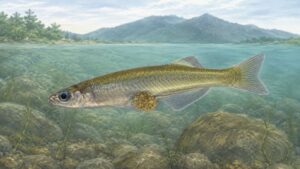
Adrianichthys oophorus is a small freshwater fish of the ricefish family Adrianichthyidae. The species is endemic to Lake Poso on the Indonesian island of Sulawesi and is notable for its unusual reproductive biology: females carry their eggs in the region between the pelvic fins.
The species was originally described by Maurice Kottelat in 1990 as Xenopoecilus oophorus. Later taxonomic studies placed it in the genus Adrianichthys, and Adrianichthys oophorus is currently accepted as the valid scientific name.
Inhaltsverzeichnis
Adrianichthys oophorus profile
| Characteristic | Information |
|---|---|
| Scientific name | Adrianichthys oophorus (Kottelat, 1990) |
| Original name | Xenopoecilus oophorus Kottelat, 1990 |
| Common name | Egg-carrying buntingi |
| Family | Adrianichthyidae |
| Order | Beloniformes |
| Distribution | Lake Poso, Central Sulawesi, Indonesia |
| Environment | Freshwater, pelagic |
| Maximum reported length | 8.5 cm total length |
| Reported common length | Approximately 6.5 cm standard length |
| Reported temperature range | 24–29 °C |
| Reported pH range | 7.5–8.5 |
| IUCN status | Least Concern |
Taxonomic note: Older publications may list this species as Xenopoecilus oophorus. The currently accepted combination is Adrianichthys oophorus (Kottelat, 1990).
Distribution and habitat
Adrianichthys oophorus is known from Lake Poso in Central Sulawesi, Indonesia. It is therefore a geographically restricted species associated with one of Sulawesi’s ancient freshwater lake systems.
The species is described as a pelagic freshwater fish, meaning that it occurs in the open-water part of its habitat rather than being primarily associated with the lake bottom.
Published fish databases report a tropical temperature range of approximately 24 to 29 °C and a pH range of 7.5 to 8.5. These values describe reported environmental conditions and should not automatically be interpreted as experimentally established aquarium requirements.
Size and morphology
Adrianichthys oophorus is a relatively small fish. A maximum total length of 8.5 cm has been reported, while a common standard length of approximately 6.5 cm is cited in the scientific databases.
The body is elongated and laterally compressed. Diagnostic characters used by taxonomists include the number of fin rays and scales as well as proportions of the head and eyes.
Reported diagnostic characteristics include:
- 8–10 dorsal soft rays
- 20–22 anal soft rays
- 58–65 scales in the lateral row
- jaws of approximately equal length
These morphological characteristics are primarily useful for scientific identification and for distinguishing the species from other members of the Adrianichthyidae.
Unusual reproductive biology
The most distinctive biological feature of Adrianichthys oophorus is its method of carrying eggs.
Females carry clusters of eggs between the pelvic fins. Individual eggs are connected to the body by multiple filaments. FishBase reports approximately 10 to 20 attachment filaments for each egg.
The eggs remain associated with the female during development, providing the basis for the English common name Egg-carrying buntingi.
Interesting feature: The species name oophorus refers to egg carrying. It derives from Greek words associated with “egg” and “to carry”, reflecting the characteristic reproductive behaviour of the species.
Taxonomy
The species was described by ichthyologist Maurice Kottelat in 1990 from material collected in Lake Poso. Its original scientific name was Xenopoecilus oophorus.
Subsequent systematic research on ricefishes resulted in its placement within the genus Adrianichthys. Eschmeyer’s Catalog of Fishes currently recognizes the following name as valid:
Adrianichthys oophorus (Kottelat, 1990)
The parentheses around the author’s name indicate that the species was originally described in a different genus.
Relationship to other ricefishes
Adrianichthys oophorus belongs to the family Adrianichthyidae, commonly known as ricefishes. The family belongs to the order Beloniformes.
The genus Adrianichthys includes several species associated with Sulawesi. Species currently recognized in the genus include Adrianichthys kruyti, Adrianichthys poptae, Adrianichthys roseni and Adrianichthys oophorus.
The restricted distributions of these fishes make the ancient lakes of Sulawesi particularly significant for freshwater biodiversity.
Conservation status
FishBase lists Adrianichthys oophorus as Least Concern (LC) according to an IUCN assessment dated 22 January 2019.
The conservation category should nevertheless be interpreted separately from geographic range. A species may have a restricted distribution while still being assessed as Least Concern when available evidence does not indicate that it currently meets the criteria for a threatened category.
Important: Adrianichthys oophorus is a species with a very limited natural distribution. Information on its conservation status and population should therefore always be based on current scientific assessments rather than inferred from its range alone.
Is Adrianichthys oophorus an aquarium fish?
Reliable scientific information about the natural history and taxonomy of Adrianichthys oophorus is available, but detailed evidence-based information about its long-term maintenance in aquaria is limited.
For this reason, environmental values reported from fish databases should not be treated as a complete aquarium-care guide. Temperature and pH data describe known or reported environmental conditions but do not establish requirements concerning aquarium size, diet, social behaviour, breeding conditions or long-term husbandry.
Where reliable husbandry data are unavailable, it is preferable not to extrapolate care recommendations from related species.
Scientific references and data sources
Taxonomic and biological information on Adrianichthys oophorus is recorded in major ichthyological databases including Eschmeyer’s Catalog of Fishes and FishBase. The currently accepted classification reflects systematic studies of the Adrianichthyidae and related ricefishes.
Important published work on the group includes taxonomic and phylogenetic studies of the ricefishes as well as investigations of the freshwater fish fauna of Sulawesi.